Choose an answer, then check the reasoning. Print the page for a paper activity.
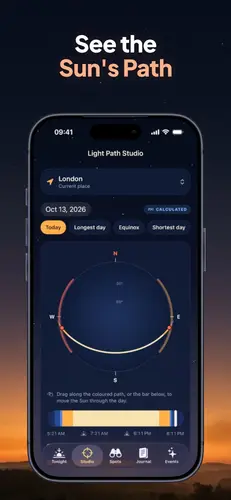
Link to this activity A bearing of 270 degrees A planning screen measures azimuth clockwise from true north. Which compass direction is 270 degrees?
East. West. South.
Read the answer and reasoning West. North is 0°, east 90°, south 180° and west 270°. A bearing gives horizontal direction, not height above the horizon.
Read the source · National Weather Service · Solar dashboard
Check the sun’s path and save the viewpoint in Asterfold. Free to download in the U.S. Open in the App Store
Link to this activity One number for height, one for direction A scout writes “elevation 4°, azimuth 250°.” Which number tells you how far above the horizon to look?
250°. The difference between the numbers. 4°.
Read the answer and reasoning 4°. Elevation measures vertical angle. Azimuth identifies the direction around the horizon. Keep the labels when sharing a scout note.
Read the source · National Weather Service · Solar dashboard
Check the sun’s path and save the viewpoint in Asterfold. Free to download in the U.S. Open in the App Store
Link to this activity The end of evening civil twilight Which solar position defines the end of evening civil twilight under the published definition?
The Sun’s centre is 6° below the horizon. The Sun’s centre is 6° above the horizon. The Sun’s centre is directly overhead.
Read the answer and reasoning The Sun’s centre is 6° below the horizon. The civil boundary uses a geometric angle below the horizon. Actual landscape brightness also depends on local conditions.
Read the source · National Weather Service · Definitions of twilight
Check the sun’s path and save the viewpoint in Asterfold. Free to download in the U.S. Open in the App Store
Link to this activity Which twilight boundary comes next? On an ordinary evening when all thresholds are crossed, the Sun has just passed 6° below the horizon. Which deeper boundary follows?
12° below the horizon. 3° above the horizon. 6° above the horizon.
Read the answer and reasoning 12° below the horizon. Civil, nautical and astronomical evening twilight boundaries progress through 6°, 12° and 18° below the horizon.
Read the source · National Weather Service · Definitions of twilight
Check the sun’s path and save the viewpoint in Asterfold. Free to download in the U.S. Open in the App Store
Link to this activity A ridge hides the sun early A mountain outlined west of your viewpoint hides the Sun before the calculated flat-horizon sunset. Which note belongs in a location record?
Change the definition of sunset for every nearby city. Keep the calculated sunset and the observed ridge disappearance as two separate times. Assume the two observations must be identical.
Read the answer and reasoning Keep the calculated sunset and the observed ridge disappearance as two separate times. An obstructed local horizon changes the visible event at that position. Record the viewpoint along with what you observed.
Read the source · NOAA · Solar calculation details
Check the sun’s path and save the viewpoint in Asterfold. Free to download in the U.S. Open in the App Store